

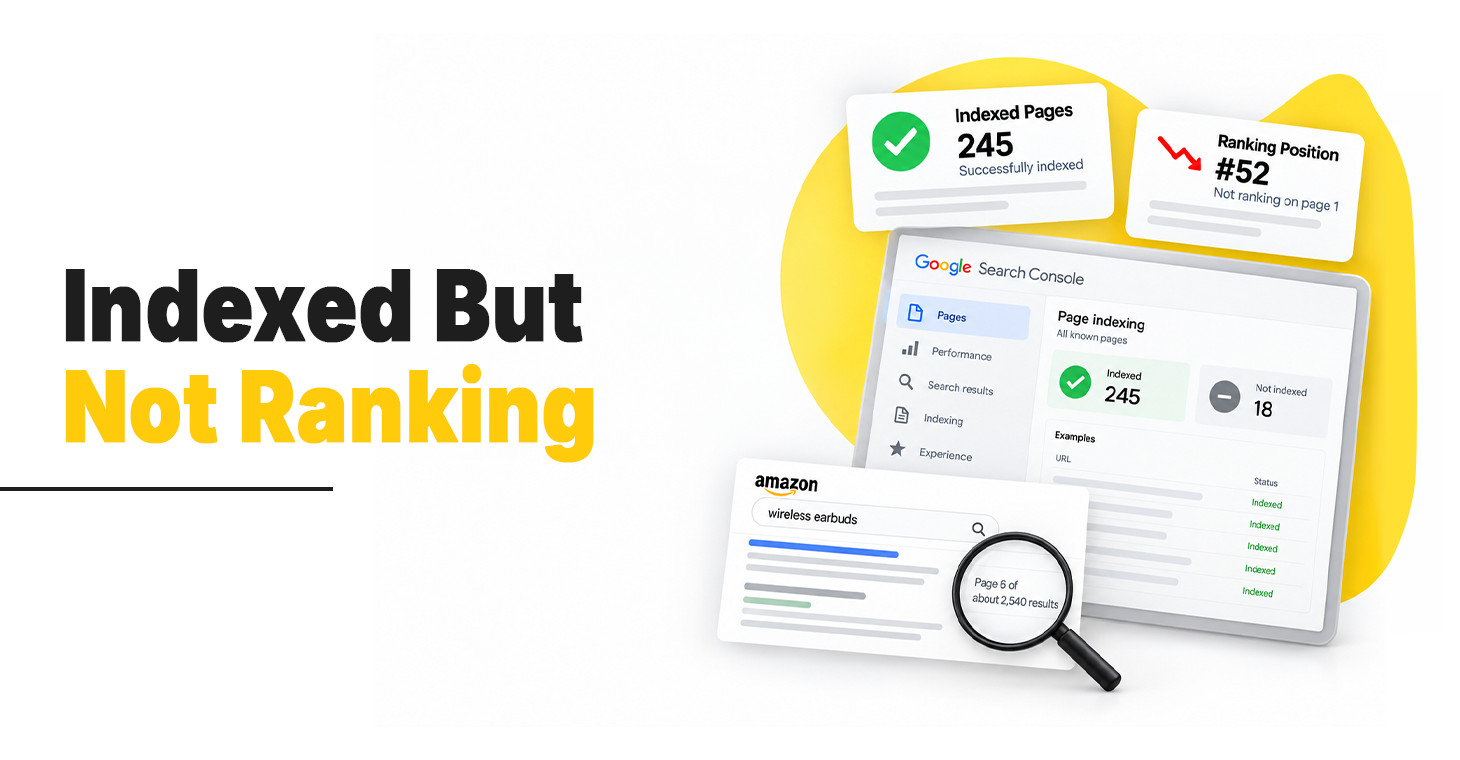
An indexed Shopify product page is available to Google, but availability is not the same as competitiveness. A page can remain in the index for months and still be invisible for commercially useful searches.
The Direct Answer
The page usually fails to rank because Google has a stronger page to show, the product page does not match the search intent, internal links are weak, the content is too similar to other products, or technical signals point toward another URL. Indexing confirms access. Ranking requires relevance, clarity, authority, and a page that genuinely helps the shopper.
When the Answer Changes
- A new store may need time and stronger site-level trust before individual products compete.
- A collection page may be correct for a broad category query, while a product page should target a specific model, feature, or use case.
- Variant and duplicate URLs can divide signals if canonical handling or internal linking is inconsistent.
- A page with impressions but weak click-through rate needs different work from a page receiving no impressions.
Practical Diagnostic Checklist
- Confirm the exact URL is indexed with Search Console URL Inspection.
- Check the user-declared and Google-selected canonical URLs.
- Identify whether the query belongs to a product, collection, guide, or comparison page.
- Review title, H1, description, specifications, images, reviews, shipping, and returns information.
- Check internal links from collections, navigation, buying guides, and related products.
- Validate product structured data and Merchant Center information.
- Compare the page with the results Google currently prefers for the target query.
Screenshot or Account Evidence
Add a Search Console screenshot showing an indexed product URL with impressions but a low average position. Pair it with a URL Inspection screenshot and remove client identifiers unless publication permission is documented.
Decision Table
| Situation | What it usually means | Recommended action |
|---|---|---|
| Indexed with no impressions | Google sees the page but may not connect it to useful queries | Improve intent alignment, internal links, and distinct product information |
| Impressions with few clicks | The snippet or offer may be uncompetitive | Improve title, price presentation, availability, and rich product data |
| Collection page ranks instead | Google prefers the broader category page | Assign broad queries to the collection and specific queries to the product |
| Wrong URL ranks | Duplicate or canonical signals may conflict | Audit variants, canonicals, redirects, and internal links |
Mistakes We Commonly Find
- Adding the same manufacturer description to every retailer page.
- Forcing broad category keywords into individual product pages.
- Assuming an SEO app automatically solves search intent and content quality.
- Publishing product variants without a clear URL and canonical strategy.
- Removing discontinued pages without evaluating existing links and demand.
Recommended Action
Choose one primary search purpose for the page. Strengthen the product information that helps a buyer compare and decide, connect the page to relevant collections and guides, and confirm that canonical and structured-data signals match the visible content. Measure impressions and query coverage before expecting sales growth.
Frequently Asked Questions
Does indexing mean my Shopify SEO is working?
Indexing only means Google can store the page. It does not show that the page is relevant or competitive enough to rank.
Should a product page and collection page target the same keyword?
Usually they should have different primary purposes. The collection can target broader selection intent while the product targets a specific item or need.
Can product schema improve rankings?
Structured data can improve how product information is understood and displayed, but it does not guarantee ranking.
How long does Shopify SEO take?
The timeline depends on competition, site history, crawling, content quality, links, and the scale of the changes. There is no fixed ranking period.
How I.E.RARE Can Help
I.E.RARE audits Shopify product pages, collections, internal linking, structured data, and search intent through our Shopify Services and Ecommerce SEO solutions.
About the Author
The I.E.RARE team works across ecommerce operations, marketplace advertising, search visibility, content, and conversion improvement. Our articles turn practical account work into clear decisions that brands can use.