



Performance Snapshot
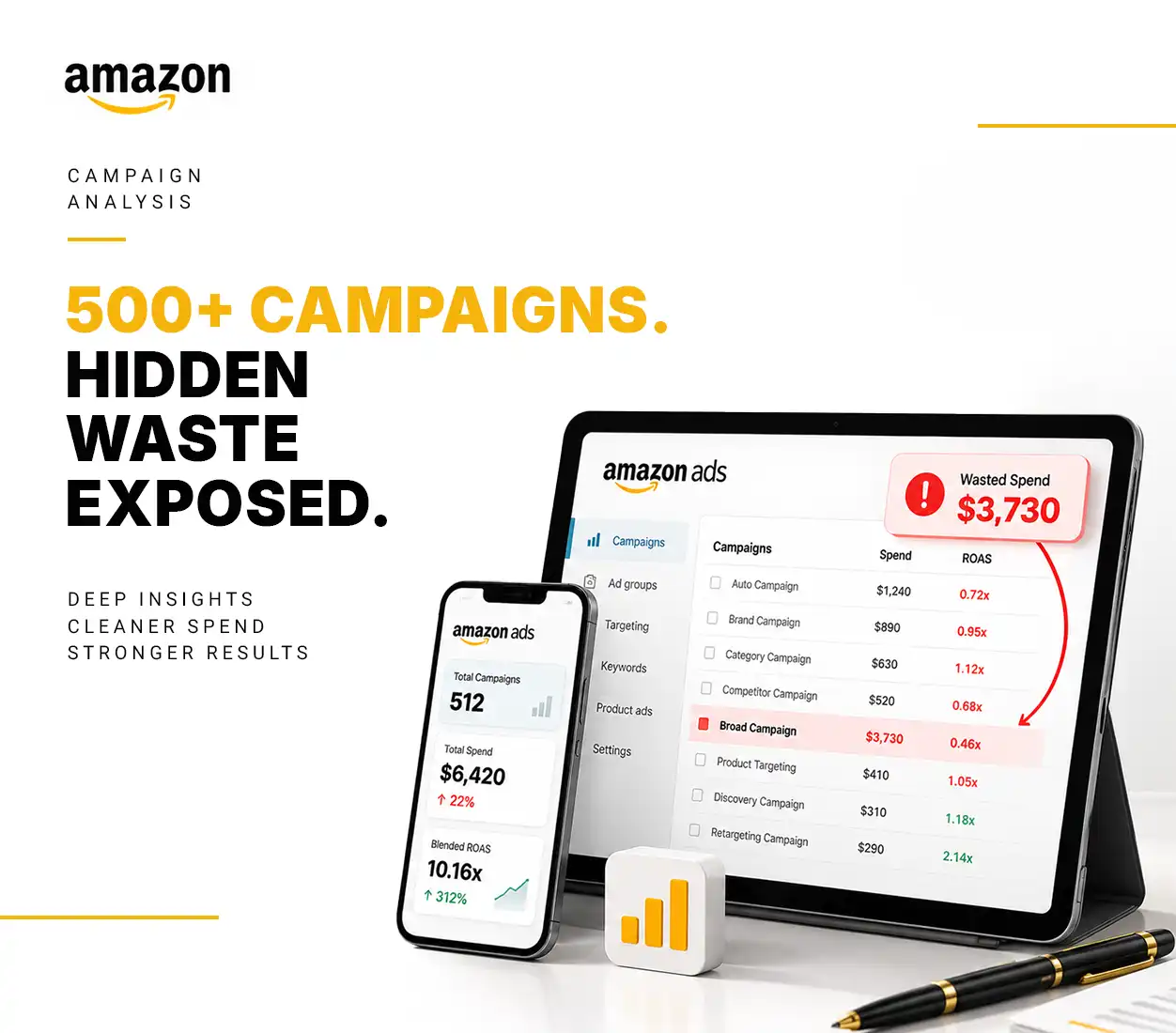
- Approximately 500 campaigns were included in the account review.
- Monthly advertising spend was approximately $100,000.
- Twenty-three percent of spend generated no attributed sales.
- Twenty-eight percent of spend either generated no sales or operated above 60% ACoS.
- Product-page placement performance was approximately 54% ACoS.
The Business
The client manages a broad Amazon catalogue supported by Sponsored Products, Sponsored Brands, and Sponsored Display campaigns. Years of campaign creation had produced a large account with overlapping structures and uneven control.
The Real Problem
The account had enough campaigns to appear sophisticated, but scale had made it difficult to see where money was being wasted. Decisions based only on total ACoS concealed unproductive targets, weak placements, duplication, and campaigns that no longer served a clear purpose.
What We Found
- A significant share of spend produced no sales.
- Poor performance was distributed across campaign types and placements.
- Product-page traffic required closer control.
- Campaign quantity had exceeded the team’s ability to manage every element consistently.
- The account needed a prioritization system before large-scale restructuring.
What I.E.RARE Changed
This was an audit engagement, so the principal deliverable was a decision-ready action plan rather than a claimed performance outcome. Campaigns were classified by sales contribution, efficiency, spend without sales, placement behaviour, and structural purpose. The findings created a sequence for pausing waste, reducing bids, consolidating overlap, and protecting proven traffic.
Before and After
| Metric | Before Audit | After Audit |
|---|---|---|
| Account visibility | Fragmented across about 500 campaigns | Prioritized action map |
| Spend without sales | 23% identified | Flagged for corrective action |
| Spend with zero sales or ACoS above 60% | 28% identified | Segmented by urgency |
| Verified post-audit result | Not supplied | Not claimed |
How the Strategy Developed
The audit moved from account-level totals to campaign, target, search-term, and placement detail. Waste was separated from strategically necessary exploration. Recommendations were then ranked by financial impact and execution risk so the internal team could act without destabilizing the whole account.
The Result
The engagement produced a clear map of where advertising money was being lost and which actions deserved priority. No post-implementation revenue or ACoS result was supplied, so none is claimed here.
What Made the Difference
- Reviewing spend concentration instead of campaign count.
- Separating exploration from persistent waste.
- Measuring placement performance independently.
- Turning audit findings into an ordered action plan.
Evidence
The study is based on supplied campaign audit totals. Screenshots, ASINs, campaign names, and client identity are omitted.
Key Takeaway
Large Amazon advertising accounts rarely need more campaigns first. They need a reliable method for deciding what should remain, change, or stop.
Frequently Asked Questions
Does spend without sales always mean a target should be paused?
No. Click volume, relevance, product lifecycle, attribution delay, and discovery value must be considered.
Why audit placements separately?
Top of search, rest of search, and product pages can produce materially different conversion and ACoS outcomes.
Is this a performance case study?
It is an audit case study. The verified outcome is diagnostic clarity, not an invented post-audit sales result.
Related I.E.RARE Service
I.E.RARE audits and restructures complex Amazon advertising accounts to identify waste, protect valuable traffic, and create a manageable optimization plan.
Related Case Studies
- Fragmented Campaigns. One Clearer System.
- Lower Spend. 10.16x Blended ROAS.
About I.E.RARE
I.E.RARE combines account-level context with campaign-level analysis, helping brands understand not only what is underperforming but what should be done next.